The most complex question for a pet parent is “ how much should i feed my dog ? The complexity of the question is due to the fact that amount of food to be given to a particular dog at a particular stage keeps on varying until your dog meets the standard parameter.
Factors that determine how much food your dog needs?
There are numerous parameters that should be taken into consideration while understanding amount of food to be given to your dog. Some of these are size ,age, gender and body condition score . These pointers play a vital role in deciding the right amount for your dog.Understanding these factors can help you create a healthy feeding routine that keeps your furry companion happy and thriving.
1. Age of your dog
Dogs have different food requirements according to their age. As the puppy takes growth ,it needs more calories and nutritional supplements to aid development. However, a balanced nutrition during adulthood is required. As they age more,senior dogs require fewer calories for maintenance with declining metabolic rate.
2.Size and Breed of Dog
Small breeds and large breeds have different energy requirements.
| Dog Size | Examples | Average Daily Calories |
| Small (5–20 lbs) | Chihuahua, Pomeranian | 200–600 calories |
| Medium (20–50 lbs) | Beagle, Cocker Spaniel | 600–1,200 calories |
| Large (50–90 lbs) | Labrador Retriever, Golden Retriever | 1,200–2,000 calories |
| Giant (90+ lbs) | Great Dane, Mastiff | 2,000–3,000 calories |
3. Activity Level
The activity level of your dog is also a deciding parameter in judging the right amount of calories it needs.An active dog burns significantly more calories than a couch-loving companion. You will have to assess if your dog has a low, moderate or high activity schedule. For instance, if your dog goes for a daily walk and have normal play sessions, it has moderate activity.However, sport breeds or hunting dogs expend their energy at a faster rate so they may require 20–40% more calories than average.
4. Reproductive Status
The reproductive status of your dog helps you to understand its portion requirements more clearly. As pregnant dogs require increased food intake especially during the last trimester and lactating mothers may need two to four times their normal caloric intake.
Sterilization alters hormonal balances, which can drop a dog’s metabolic rate by roughly 20–25% shortly after the procedure. If your pet was recently fixed, keep a close eye on their waistline and scale back portions slightly if they start putting on weight.
5. Body Condition Score (BCS)
Veterinarians use the Body Condition Score to determine whether a dog is underweight, ideal, or overweight. If your dog is underweight then you should gradually increase calories and decrease calories if it is overweigh. With obese condition, you need to control the condition by monitoring its weight through a guided weight- loss plan.
6. Food calorie density
All dog food is not created equal. A cup of high-protein, grain-free kibble might pack 450 calories, while a weight-management formula might only have 280 calories per cup.
The type of food offered to your dog has different amount of calories. For instance, dry food ,kibble has higher calorie density while wet food has lower calorie density. Homemade diets must be nutritionally balanced for the optimum growth of your dog.
Treats should make up no more than 10% of daily calorie
Rule of Thumb: Always look for the kcal/kg or kcal/cup print on the back of your pet’s food bag rather than relying strictly on scoop volume.
How to Test If You Are Feeding the Right Amount?
The scale only tells half the story. The absolute best way to monitor your dog’s portion control is by tracking their Body Condition Score (BCS) right at home using a quick three-step physical check:
The Rib Check: Place your hands flat on either side of your dog’s ribcage. You should easily feel each rib under a thin layer of fat without having to press hard. If you have to dig, they are overfed.
The Waist Check: Stand directly over your dog and look down. They should have a visible, tapered waistline that narrows inward right behind the ribs and before the hips.
The Tummy Tuck: Look at your dog from the side. Their abdomen should gradually slope upward from the bottom of the ribcage toward their hind legs, rather than hanging straight or sagging.
If your dog lacks a waist and feels thick over the ribs, reduce their daily food intake by 10%. If their ribs or hip bones are visibly jutting out, increase their daily portion by 10% and monitor them over the next two weeks.
How To Calculate Right Amount Of Calorie Intake Of My Dog?
Here is a simple formula for calculating the right amount of calories by understanding the activity levels and RER and MER for your dog.

Puppy Feeding Chart
Puppies need frequent meals and calorie-rich diets to support growth.
| Puppy Weight | Dry Food (Daily) | Wet Food Equivalent | Calories Per Day | Feeding Schedule | Treats |
| 5 lbs | ¾ cup dry | 1 can wet food | 300 calories | 4 meals/day | Small training treats |
| 10 lbs | 1¼ cups dry | 1½ cans wet food | 500 calories | 3–4 meals/day | Limited treats |
| 20 lbs | 2 cups dry | 2½ cans wet food | 900 calories | 3 meals/day | Healthy treats |
| 40 lbs | 3½ cups dry | 4 cans wet food | 1,500 calories | 3 meals/day | Less than 10% calories |
| 60 lbs | 4½ cups dry | 5 cans wet food | 2,000 calories | 2–3 meals/day | Moderate treats |
Adult Dog Feeding Chart
Adult dogs generally do best with two meals a day.
| Adult Weight | Dry Food (Daily) | Wet Food Equivalent | Calories Per Day | Feeding Times | Treat Allowance |
| 10 lbs | ½–1 cup | 1 can | 350 calories | Morning and evening | Up to 35 calories |
| 20 lbs | 1–1½ cups | 1½ cans | 700 calories | Twice daily | Up to 70 calories |
| 40 lbs | 2–2½ cups | 2½ cans | 1,100 calories | Twice daily | Up to 110 calories |
| 60 lbs | 3–3½ cups | 3½ cans | 1,500 calories | Twice daily | Up to 150 calories |
| 80 lbs | 4–4½ cups | 4 cans | 2,000 calories | Twice daily | Up to 200 calories |
Senior Dog Feeding Chart
Senior dogs generally require fewer calories because they are less active.
| Senior Weight | Dry Food (Daily) | Wet Food Equivalent | Calories Per Day | Feeding Schedule | Treat Recommendation |
| 10 lbs | ½ cup | ¾ can | 250 calories | Two meals/day | Low-calorie treats |
| 20 lbs | 1 cup | 1¼ cans | 500 calories | Two meals/day | Limited treats |
| 40 lbs | 1½–2 cups | 2 cans | 850 calories | Two meals/day | Joint-support treats |
| 60 lbs | 2½ cups | 3 cans | 1,200 calories | Two meals/day | Less than 10% calories |
| 80 lbs | 3–3½ cups | 3½ cans | 1,600 calories | Two meals/day | Healthy snacks only |
Common Feeding Mistakes Dog Owners Make
There are some common errors we tend to ignore while feeding your dog.
1.Using a random plastic cup:
The first and foremost mistake while feeding your dog comes by using a random plastic cup. You should use the actual measuring cup or weigh the food on a digital kitchen scale for perfect consistency.
2.Leaving the bowl full all day:
Free-feeding (leaving food out 24/7) frequently triggers overeating out of boredom and makes it impossible to monitor sudden changes in appetite, which are often the first indicator of illness.
3.Ignoring the “Treat Tax”:
Treats, dental chews, and table scraps count toward your dog’s daily limits. Veterinary nutritionists recommend that treats make up no more than 10% of your dog’s total daily caloric intake.
4.Following Generic Charts:
Individual dogs have different food requirements and hence you should not blindly follow the packaging guidelines.
5.Not adjusting portion with Age:
As your dog takes growth, you need to alter the portion size and timings of its feed.
6.Switching foods too quickly:
You need to understand your dog’s response to a particular diet and it take time.Therefore, you won’t be able to assess its actual reaction if you keep switching up the meal type too quickly.Moreover,sudden dietary changes can upset your dog’s digestive system.
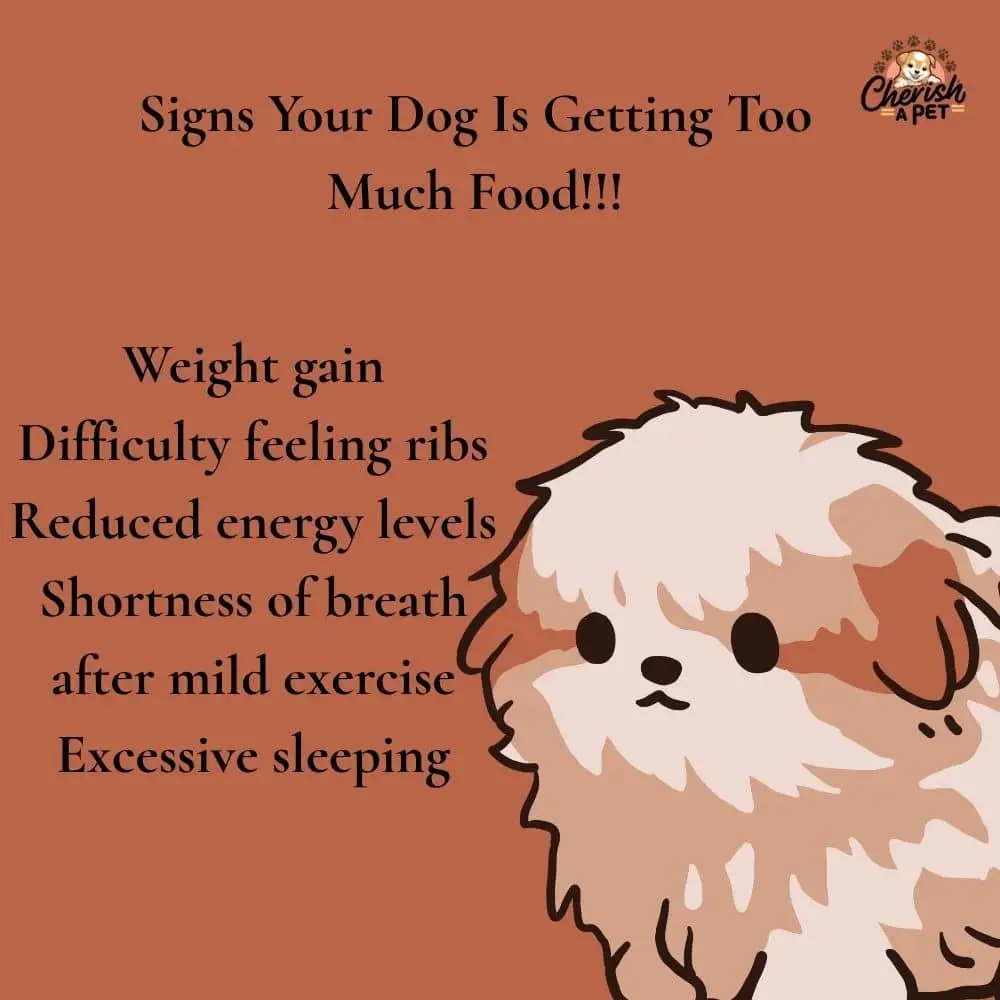
Signals You Should Notice While Overfeeding Your Dog
Signals You Should Notice While Underfeeding Your Dog

Frequently Asked Questions
Question 1: How many times should I feed my dog?
Answer: The puppies need 3-4 meals/day, adult dogs need two meals/day. The senior dogs should be given smaller meals twice a day.
Question 2: What is RER and MER?
Answer: These terms indicate calorie requirement of a dog. RER means Resting Energy Requirement. These is minimum energy required for breathing and resting whereas MER means Maintenance Energy Requirement. These calories are required for sustaining life with normal activity levels.
Question 3: How do i calculate the amount of calories needed by my dog?
Answer: You need to understand the Maintenance Energy Requirement(MER) and Resting Energy Requirement (RER) for your dog. First of all use a general formula for calculating these two parameters.
Question 4: Why are the feeding guidelines on my dog food bag so high?
Answer:Dog food packaging charts are broad generalizations designed to prevent malnutrition across an entire weight class. Commercial bag guidelines frequently overestimate required portions by 10% to 20%.
Question 5: Can I mix wet and dry food?
Answer: Yes. Many dog owners successfully combine both, provided the total calories remain appropriate.
Question 6: How much should I increase food portions for an active or working dog?
Answer: A If your dog exercises intensely for more than two hours daily, increase their baseline meal portion by 10% to 20% increments until their body condition stabilizes, or switch to a performance formula.
Question 7: How much should I feed my dog to help them lose weight?
Answer: A healthy weight reduction velocity of 1% to 2% of their total body weight per week can be achieved by reducing their existing daily amount by 10% to 20%.
Conclusion
One of the most crucial elements of maintaining the health and happiness of your dog is feeding them the right quantity, which goes beyond simply filling a dish. You can provide your dog the proper nourishment and support a long, active life by taking into account factors like age, size, lifestyle, and physical condition.